
AI-assisted, fast and scalable video production
VR experiences for trade shows, events and training
Touchscreen kiosk software and hardware
3D hologram display and stage solutions




Virtual Reality vs Augmented Reality: What Are the Differences?
Learn the differences between virtual reality and augmented reality. Explore the VR-AR-MR comparison and use cases across industries.

In corporate technology investments, the difference between virtual reality and augmented reality is often less about the choice of hardware than the choice of scenario. This guide compares the working principles of VR and AR, how mixed reality combines the two technologies, cost and hardware expectations, and which technology serves which business goal in trade show, training and field applications. In projects where the wrong choice is made, what is lost before the budget is the visitor's attention.
What Is Virtual Reality (VR)?
Virtual reality transports the user into a computer-generated environment through a headset that completely covers their field of view. The physical space drops out; when users turn their heads, they see not the office wall but the continuation of the designed scene. This full isolation is the defining feature that sets VR apart from other visual technologies, and it also determines the conditions of use. Because an isolated experience cuts the user off from their surroundings, it requires a safe area, a supervisor and a limited duration.
On the corporate side, the return on this isolation is concentrated attention. Stepping inside a factory, standing next to a machine that has not yet been built or experiencing a dangerous scenario without risk is only possible in an environment where external stimuli are completely cut off. What the user sees, where they look and in which order they receive which information is managed by the design. This level of control becomes decisive in training and promotional scenarios where the message must be delivered in full.
How Does VR Work?
A VR experience emerges from three components working at the same time. The headset creates a sense of depth by sending a separate image to each eye. Sensors inside and outside the headset measure the turning and tilting of the head and its position in the space within milliseconds. The software then takes this motion data, recalculates the scene and puts the new frame on screen. As long as the delay between movement and the image update stays below a certain threshold, the brain accepts the scene as real.
Hand controllers or hand tracking add an interaction layer to this loop. When the user turns a valve, opens a panel or lifts the cover of a product, the system processes this input like a physical action. A similar logic is also used, with a lighter production process, in 360-degree virtual tour applications. There the scene is recorded from a real space, whereas in VR it is fully modelled.
VR Use Cases
What the scenarios where full isolation stands out in corporate projects have in common is that the element to be explained does not yet exist physically, or showing it in a real environment carries high cost or risk. The use cases where this approach stands out are:
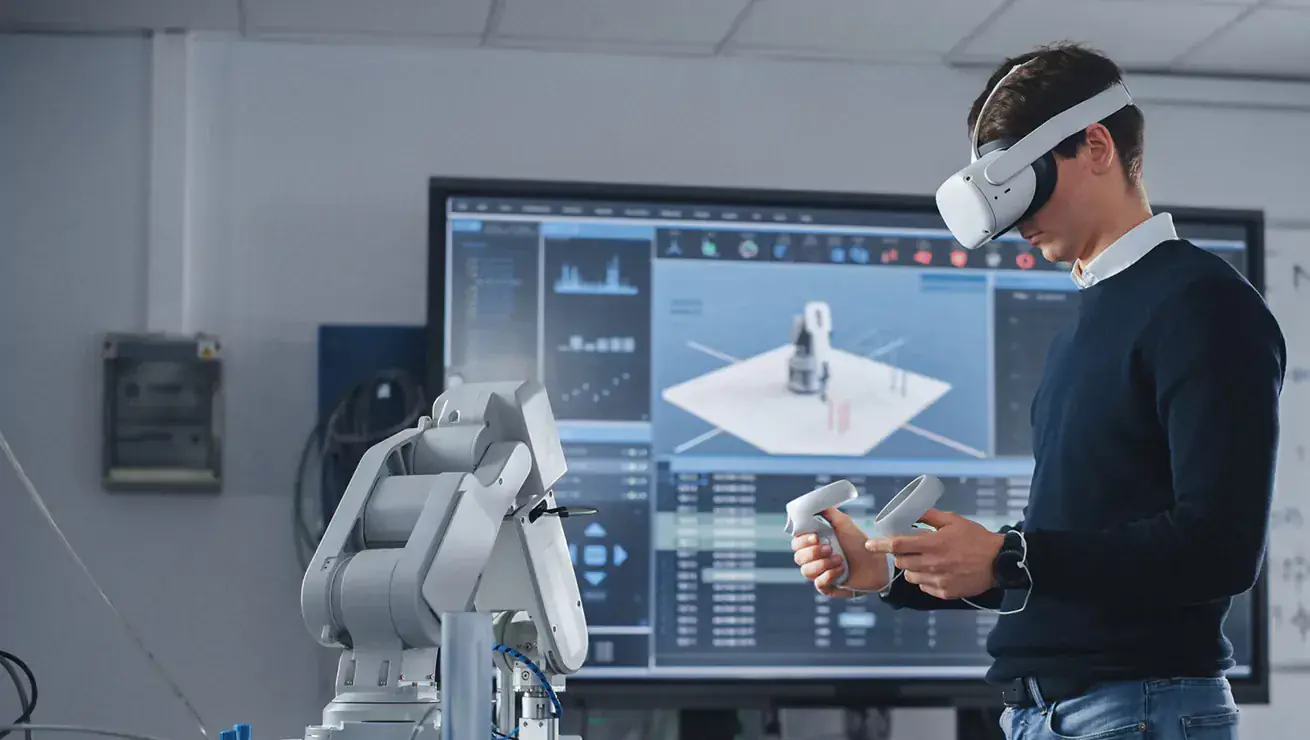
Training for dangerous equipment and emergencies is practised again and again without any real risk.
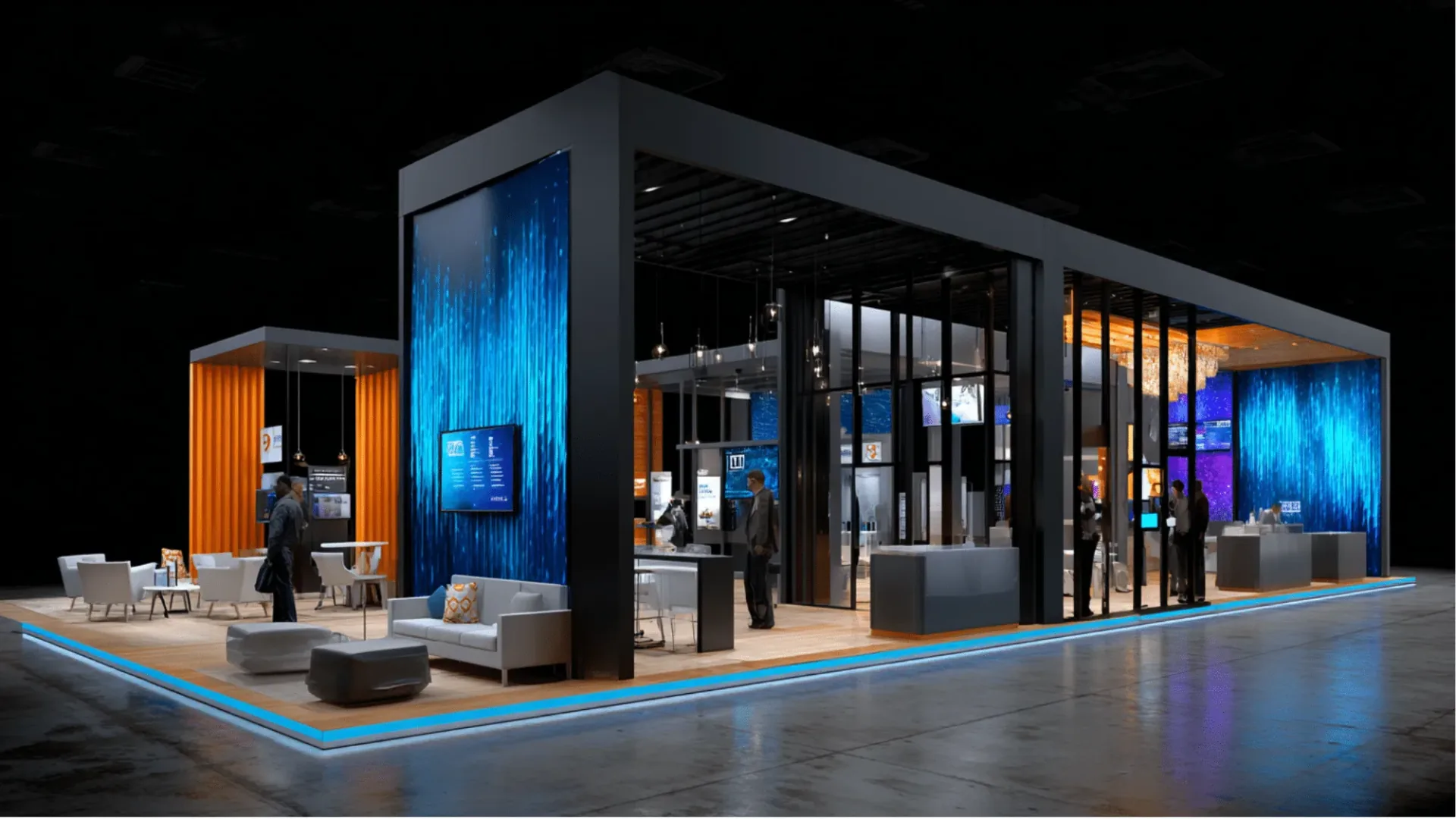
On a trade show stand, visitors are taken on a tour inside a facility that cannot be transported.
Products not yet manufactured are examined and tested at their real scale.
Production lines and process flows are tried out with a factory simulation approach before they are commissioned.
Architectural projects are presented to investors with a real sense of space before construction begins.
What Is Augmented Reality (AR)?
Augmented reality adds a digital layer on top of the real world instead of removing it. Users continue to see the space they are in; a model, text, arrow, measurement or animation is overlaid on this view on a phone screen or the lens of transparent glasses. Preserving the physical context is the fundamental quality that distinguishes AR from virtual reality, and it directly determines where the technology is used.
This layered structure makes it possible to tie digital content to a real object. A phone held over a device can show its internal structure, a full-size machine can appear on a table, or a catalogue page can come to life. Users see the product and the explanation at the same time. Because attention is not split, AR resonates strongly in sales and service scenarios where information needs to be delivered together with the object itself.
How Does AR Work?
AR relies on three elements working together. The camera continuously captures the surrounding environment. The software recognises surfaces, edges or predefined markers in this image and calculates at which point and at what angle the digital content will be placed. The screen then displays the real image and the calculated layer on top of each other. As the device moves, the software re-measures its position and keeps the virtual object fixed to the real ground.
Because all three of these are found in a standard smartphone today, the barrier to accessing AR is low. In corporate projects, content is mostly opened through an app, a web browser or a QR code. In heavier scenarios, AR glasses with transparent lenses come into play and leave the user's hands free; this is a decisive detail for technicians carrying out maintenance in the field.
AR Use Cases
In the areas where AR technology stands out, digital content gains meaning by interacting with the physical world. The use scenarios that preserve the real-world context are:
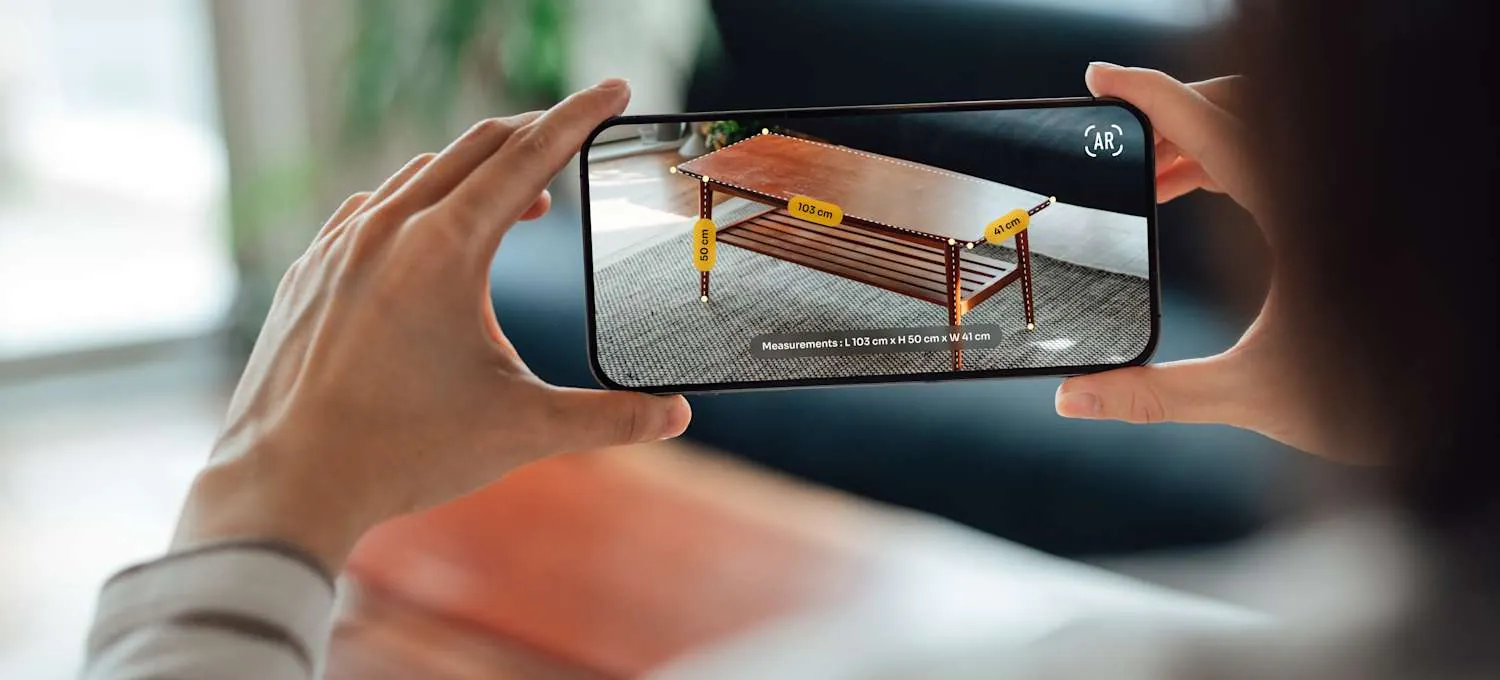
In retail, customers see the product at its real scale in their own home or on themselves.
In technical service, troubleshooting steps are shown by marking them on the device being serviced.
Using AR on a trade show stand lets visitors join the experience on their own phones and explore products without queuing.
In training, a complex mechanism opens up layer by layer on top of printed material.
In showrooms and stores, product variants are displayed without the limits of shelf space.
Key Differences Between VR and AR
Comparing VR and AR technologies makes it easier to evaluate their differences through concrete project needs. You can review the key differences between virtual reality and augmented reality in the table, across five decision criteria that stand out in corporate projects:
Criterion | Virtual Reality (VR) | Augmented Reality (AR) |
Level of isolation | Full isolation; the physical environment is completely blocked | Partial layer; the physical environment stays visible |
Hardware requirement | Dedicated headset, controllers and a safe usage area | Smartphone, tablet or glasses with transparent lenses |
Type of interaction | Hand controllers, hand tracking and gaze direction | Touchscreen, camera direction and gestures |
Cost structure | Hardware and scene production are budgeted together | Production-heavy; hardware is mostly the user's own |
Typical scenario | Training, simulation, spatial experience | Product presentation, field support, point of sale |
Differences in User Experience
In terms of user experience, the differences between virtual reality and augmented reality come down to depth versus reach; the VR experience is deep, while the AR experience is widespread. A user wearing a headset usually focuses on a single narrative for three to five minutes, and no other stimulus comes into play during that time. This intensity increases retention, but only one person is addressed at a time. That is why operational topics such as queuing, staff guidance and hygiene become part of the design.
On the AR side, the equation is reversed. The experience is shorter and stays more superficial, but in return dozens of people can access the same content from their own devices at the same time. After users finish the experience, the content stays on their phone, which creates an advantage for follow-up and recall. The choice is a trade-off between deep impact and wide reach.
Differences in Hardware and Cost
The difference between virtual reality and augmented reality also becomes clear in hardware requirements. VR projects often need more than one unit, in addition to headsets, spare batteries and cleaning supplies. This equipment creates a need for regular maintenance and operation, especially throughout a trade show. Hardware costs can also be affected by rising component prices. Indeed, according to IDC data, Meta raised the prices of its Quest 3 and Quest 3S models in April 2026 to reflect memory chip costs.
On the AR side, most of the hardware burden is in the user's pocket. Investment shifts towards content production and software development; keeping extra devices at the stand remains optional. When total budgets are compared, AR usually comes in at a lower starting cost, but in return it does not produce the same impact that VR leaves on a single user.
Differences in Corporate Use
Once the business goal is defined, the choice of technology largely becomes obvious. Corporate VR applications stand out in projects that aim to change behaviour, teach a process or make a strong first impression. AR works more efficiently in projects that aim to remove hesitation at the moment of purchase, support a team in the field or reach a wide audience quickly. In VR and AR application development, when the difference between virtual reality and augmented reality is clarified before the technical specification, revision costs drop noticeably.
What Is Mixed Reality (MR)?
Mixed reality combines VR's power to create virtual objects with AR's ability to preserve the real space in a single device. The user wears a headset but, thanks to external cameras, continues to see their room; virtual objects sit on the real table and disappear behind the real wall. Objects recognising the physical environment is what separates mixed reality from a simple image overlay.
On the market side, this category carries a significant share of the volume. According to IDC's Q2 2026 data, mixed reality headsets accounted for 49.3 percent of total shipments, while lightweight extended reality glasses grew by 79.8 percent in the same period to reach 46 percent of the market. This shift on the hardware side also explains why producing device-independent content is becoming increasingly meaningful in corporate projects.
How Does MR Differ from VR and AR?
The key difference between VR, AR and MR is the extent to which the real world is preserved in the experience and how it interacts with digital content. In VR, the real world is completely switched off and a virtual environment is created. In AR, the real world stays visible and digital content is added on top of it. In MR, digital objects interact with physical surfaces, forming relationships such as depth, shadow and collision. From this perspective, the difference between VR, AR and MR can be explained through the connection the user maintains with the real world. MR is a suitable option for projects that offer more advanced interaction with digital objects while preserving the context of the real environment.
How Should Businesses Choose the Right Technology?
The decision progresses soundly when it starts from the goal rather than the technology; only at this point does the difference between virtual reality and augmented reality turn into a practical selection criterion. How many people will be reached, how much time can be given to each person, whether the experience is tied to a real object and whether the project will live on after the trade show are the four basic questions. In trade show and exhibition projects, when these four topics are evaluated together with the stand's square metres, the choice of technology becomes largely clear.
Industry expectations also support this decision. According to IDC's headset market forecast, the AR and VR headset market will grow by 9.5 percent in 2026 and expand at a compound annual rate of 38.4 percent between 2026 and 2030. In other words, hardware variety will increase in the short term, while content will retain its value independently of the device.
When Should VR Be Chosen?
The situations where full isolation is worth its cost are quite clear. If several of the following conditions apply at the same time, VR stands out as a strong candidate:
If the space or facility to be explained cannot be physically transported.
If the scenario is dangerous, expensive or impossible to repeat in real life.
If the goal is to make a strong impact and be remembered in a short time.
If there is an area and staff that can devote a few minutes to each visitor.
If the product has not yet been manufactured or is too large for its scale to be shown. At this point, a VR trade show experience removes the physical limits of the stand area.
When Should AR Be Chosen?
AR stands out in projects where preserving the real-world context is important. The AR use scenarios that offer ease of access and a cost advantage are:
If the digital content gains meaning on a real product or device.
If a large number of people need to be reached at the same time.
If the experience is expected to stay with the user after the trade show.
If staff capacity and queue management at the stand are limited; using a touchscreen kiosk on a trade show stand together with AR content speeds up the flow.
If field teams need to access information while keeping their hands free.
Frequently Asked Questions About Virtual Reality and Augmented Reality
Is VR or AR more expensive?
In the total project budget, VR usually makes up a higher item, because headset hardware, spare units and the usage area add to the cost. In AR, since most of the hardware is the user's own phone, the starting cost falls. However, comparing on hardware alone is misleading; in both technologies, the weight of the budget is determined by scene quality, the number of interactions and production time.
Should VR or AR be used on a trade show stand?
The stand area, the target number of visitors and the number of staff on duty determine this decision. On stands aiming for a limited number of qualified conversations per day, VR makes the time given to each visitor valuable. On stands with heavy foot traffic and short contact times, AR reaches more people. When evaluating ways to attract attention on a trade show stand, positioning the two technologies together is also a frequently preferred approach.
Are special glasses required for AR?
Most corporate projects run on smartphones and tablets; special glasses are not mandatory. AR glasses with transparent lenses make sense in maintenance, assembly and warehouse operations where the user's hands need to stay free. In promotional, sales and trade show scenarios, a device-independent application widens access and keeps visitors in an interface they are used to.
Does VR cause motion sickness?
The feeling of discomfort mostly stems not from the technology itself but from how the software is designed. The image responding late to head movement, or the scene being moved without the user's own movement, triggers this effect. When fixed-position scenes, teleport-style movement and high frame rates are preferred, complaints drop noticeably. Limiting the experience to a few minutes is also used as an effective measure in trade show environments.
Can VR and AR be used together?
Because the same 3D assets can be used in both technologies, projects designed together create a cost advantage. A common model is to offer an in-depth VR experience at the stand while leaving AR content on the visitor's phone; this way, contact continues after the trade show. Once modelling is done, the same assets can also be reused in trade show animation and promotional materials.
Blog
All posts→
Your next project
Let's build
together.